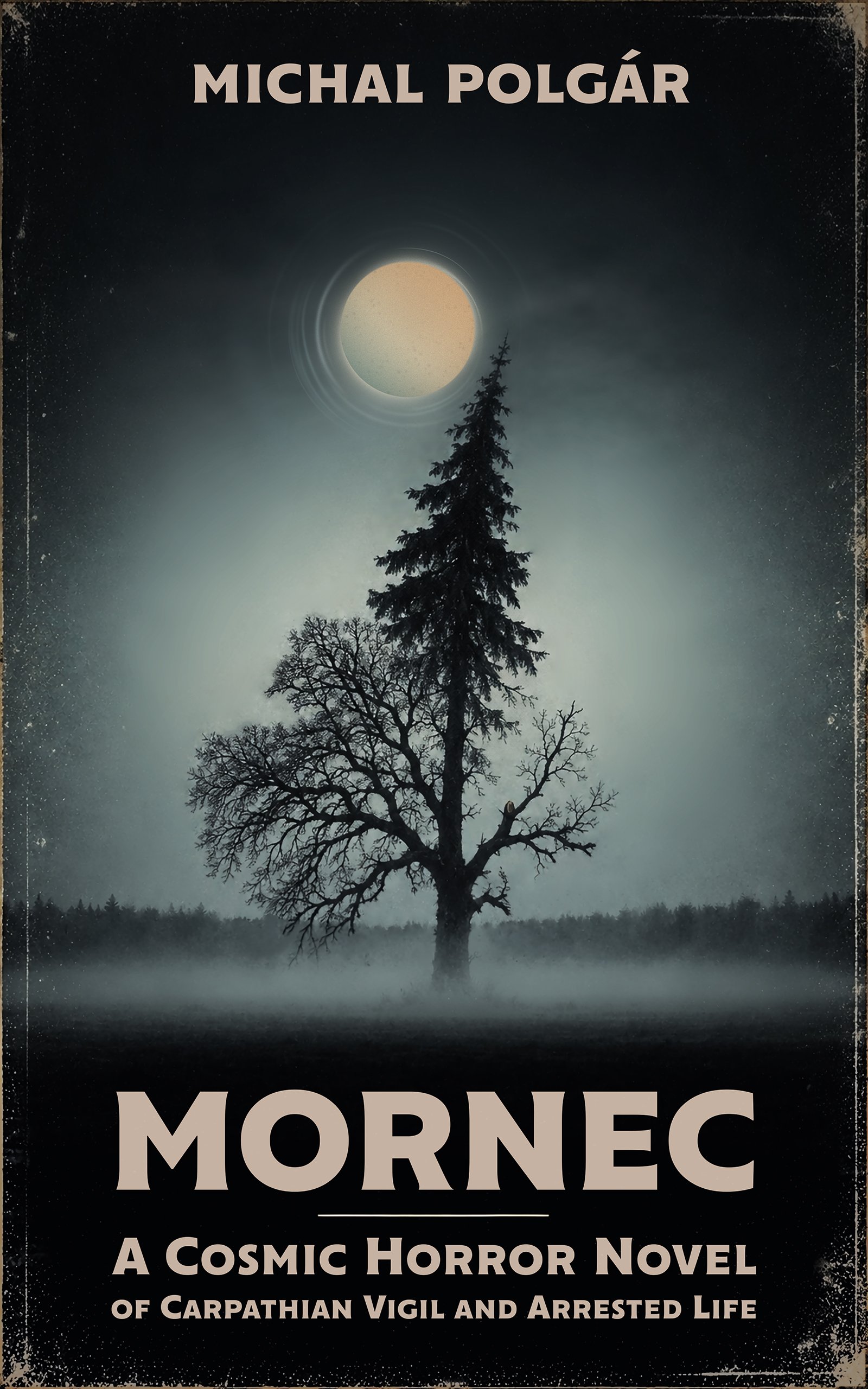
Quiet Ends · II · 48°43′ N
A Cosmic Horror Novel of Carpathian Vigil and Arrested Life
Mornec
Filip Hrehuš keeps bees in a clearing above Mornec, a mountain village in the Slovak Carpathians, and knows the forest around him better than he knows most people. He is the first to hear it going quiet.
The honey is what he and his mother live on, and the hives are the one part of his life that has always given back what he put into it. This October the hum inside them is wrong. In the youngest colony, the one he raised this year, the comb stands perfect and every cell is dry. The bees that are left are still moving. None of it is work.
The hives are only the first thing. Through the last weeks of October the valley goes on changing, a little at a time, from the forest floor to the sky his grandfather taught him to name. For every change Filip finds a reason. By November the reasons have run out. And the old trouble he has carried since boyhood, the one that has never had a name, is coming back.
His mother, Katarína, has been ill since the spring and has not been past the doorstep in weeks. As far as she knows, the valley is still the one she was born in. Filip keeps the stove fed, the lamp lit, and himself between his mother and the window.
A slow-burn novel of literary cosmic horror, Mornec is the story of a son and his mother, told by a man who has spent his life reading one small piece of ground, in the autumn it stops answering to anything he knows.
Series
Quiet Ends, Book Two. Stands alone.
Editions
Kindle ebook and paperback.
Paperback
324 pages · 5 × 8 in · ISBN 978-82-694333-1-9
Setting
A mountain village in the Slovak Carpathians.
Published
1 November 2026
From the opening
Chapter I · The Plain in the Woods
The pines had grown closer to the house than I remembered. Standing at the kitchen window in the early light, I could see how the treeline had thickened over the years my attention had been elsewhere. The younger growth had filled the gaps between the old trunks. A wall of colour now. The green of summer gone to rust and harvest.
The forest did not move. Nothing moved.
Our house sat alone in a clearing my grandfather had called samota. A small plain in the woods, ringed on three sides by forest and open on the fourth where the ground fell away towards the valley. The clearing was perhaps sixty metres across, the grass still green at its centre but browning where the shade of the pines reached it first. A single dead tree tilted near the middle.
From where I stood, pieces of the village showed through the gaps where the slope fell away. Mornec. A few rooftops, the upper half of the church spire, woodsmoke rising from chimneys the land had swallowed. At that hour five chimneys were up in it and no more. The Vičeks’ at the low end first, always. The rest of Mornec would not show itself until the light was properly down in the valley.
The nearest neighbour was old Marta. Twenty minutes through the trees, and even then only if you knew which path to take. Her smoke came up out of the beeches below the second bend, a thin line that the wind above the canopy took apart before it had cleared the crowns. She had it going before the light and she had it going before mine. In all the years I had been the first up in this house I had never once been the first up on this hill.
The house was up the track, in the woods, alone in its clearing, and it had been this way for longer than anyone alive could account for.
The honey was what kept us. Not comfortably, but sufficiently. We sold jars at the market in Mornec and traded others at Reiner’s for butter, and for eggs when the hens were laying. His wife had done the dairy end of that house and he had done the beasts. Since she died in the spring he had done both, and it showed in the butter.
That income was small, steady, and entirely dependent on the health of what lived inside those boxes. I had plans for them. Insulated frames for winter, to keep the cluster from shrinking when the cold worked through the wood. A new extractor, because my grandfather’s rattled now with the looseness of metal asked to work past its patience. Perhaps a trial with buckwheat.
It was dark and strong and sold well. That was the thought I got up into most mornings. It put my hand to what I had and kept it off what I had not.
Materials were expensive. I set aside what I could. The folded notes in the wooden box in the back room had thickened by a centimetre over the year. Not yet fresh foundation. Not yet the new extractor.
October had come in cold this year. The mornings came with frost on the grass and a sharpness in the air that the sun took an hour to burn off. The resin smell of the pines mixed with the damp of fallen leaves and the cool, clean scent of stone.
At night, and sometimes in the early morning, the stags called from the ridges above the ravine. The deer rut was running late this year. Their voices carried across the valley in long, low bellows that rose and broke and faded.
When I was young, I divided these woods in my mind. The Black Forest, where the pines grew tallest and their canopy sealed the sky. The White Forest, to the east, where the trees thinned and the light came through. The Green Forest, where the spruces ran out towards the gully. Deer Ravine. Stone Bend. Names that meant nothing to anyone but me, and still do.
“My grandfather used to say the land remembered. He did not explain what it remembered.”
Mornec · Chapter I
Also in Quiet Ends · I · 72°40′ N