Krelløy Review by Michael A. Morrison
Michael A. Morrison wrote this deep review and analysis of Krelløy. I am grateful for the care he took over it. It means a great deal to me, and I publish it here with his permission.
Krelløy. A tiny, remote Norwegian island north of the Arctic circle. A fishing village: population 47. Unaware that about to descend upon them are cosmic forces that will change their reality forever. Over the village looms Trallhornet, the mountain that will become the locus of those forces: “Trallhornet…rose from the island’s flesh like a question mark, its angles etched in a geometry my Central European mind had never dared to contemplate.”
The (quite accurate) subtitle of Krelløy is “a Lovecraftian Horror Novel of Arctic Isolation and Cosmic Annihilation.” Lovecraftian horror is not the mere presence of Cthulhu and his pals. It’s an encounter with the unknowable: cosmic forces of unknown origin, indifferent to and unaware of humans which nonetheless can inflict, terror, death, and profound changes in reality itself: “Krelløy will become a hybrid space, where both realities can coexist.…We’re witness to something unprecedented. The birth of a new form of reality”. This is Lovecraftian horror, so named because its most well-known author was H. P. Lovecraft: “I had been noticed by something that regarded our entire civilization the way we might notice bacteria under a microscope: with detached curiosity and the power to annihilate without malice or even awareness.”
Rarely have I come across a work that so powerfully and poetically evokes the combination of sublime awe and terror that radiates for every page of this novel. Although the origin and nature of the phenomena transforming Krelløy, its landscape, and its inhabitants is unfathomable, there seems to be an underlying logic or pattern that keeps the novel from being just a series of escalating incidents.
Throughout, Polgár’s carefully crafted prose induces a sense that something inexplicable and deeply wrong is infecting Krelløy: “Outside, something that might have been wind or might have been breathing pressed against our walls. The house creaked its familiar creaks, but tonight they kept time with the pulsating light from the beach.” The unease this sense induces permeates every page, intensifying until the novels’ horrifying, tragic, yet strangely moving end. (At its heart, Krelløy is a love story.)
At times redolent of writing by Ramsey Campbell (The Voice of the Beach); at others, J. G. Ballard (The Crystal World), at still others Lovecraft himself (“The Colour Out of Space”, “The Dreams in the Witch House”), Polgár’s prose is uniquely his own, the engine that drives the novel forward: “The tear [above Trallhornet] widened as we watched, splitting the air like a wound that refused to clot. From its raw center spilled revelation, a sensory light that pressed against the skin and mind.”
Read Krelløy slowly. Allow it to work on your imagination. Read it aloud. Read it to friends. Above all, don’t miss this quintessential tale of Lovecraftian horror. If Amazon permitted I’d give it seven stars.
Michael A. Morrison · November 2026
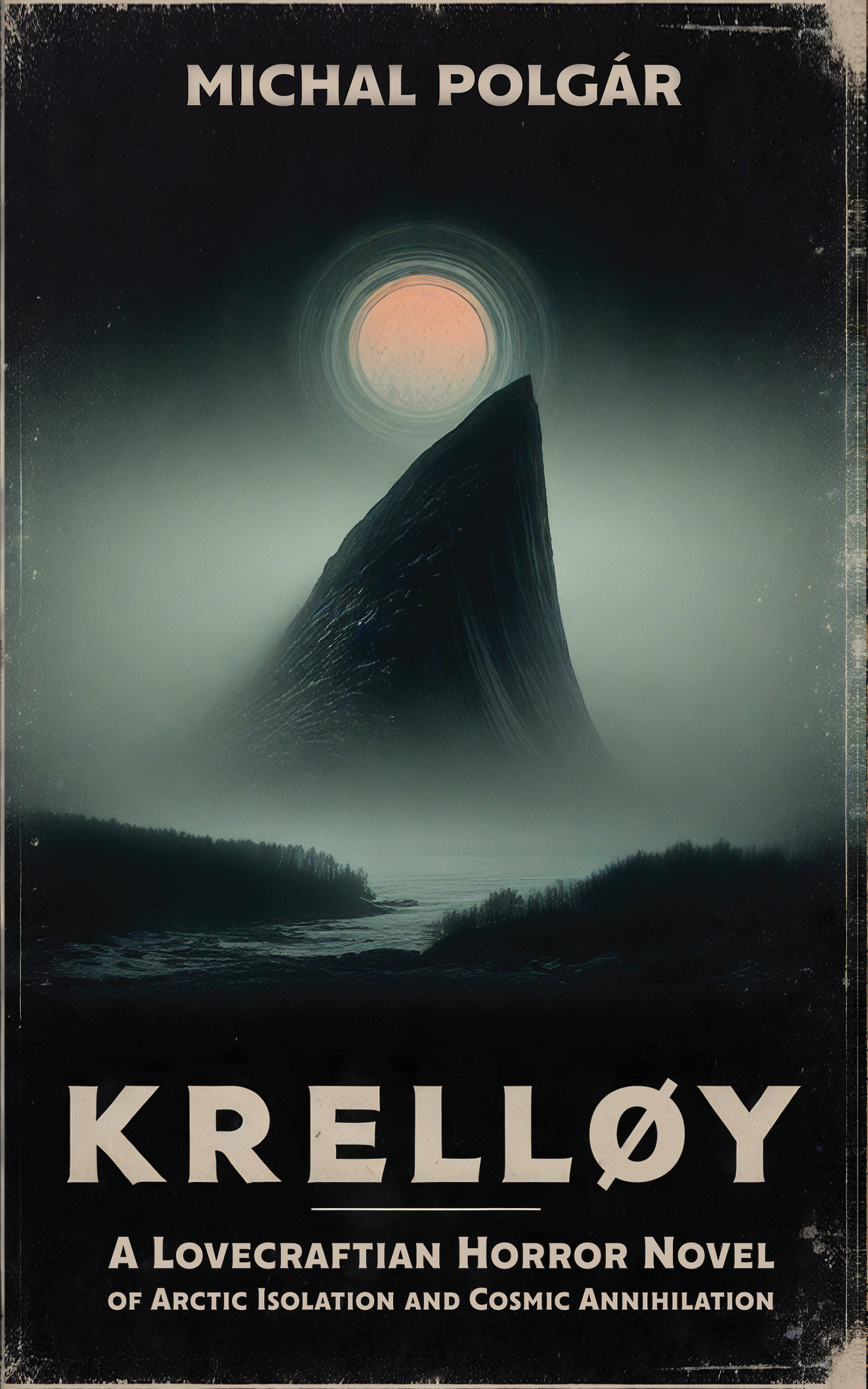
Krelløy
A Lovecraftian Horror Novel of Arctic Isolation and Cosmic Annihilation